
The Crime of the Century and the Florida Keys Sailfish
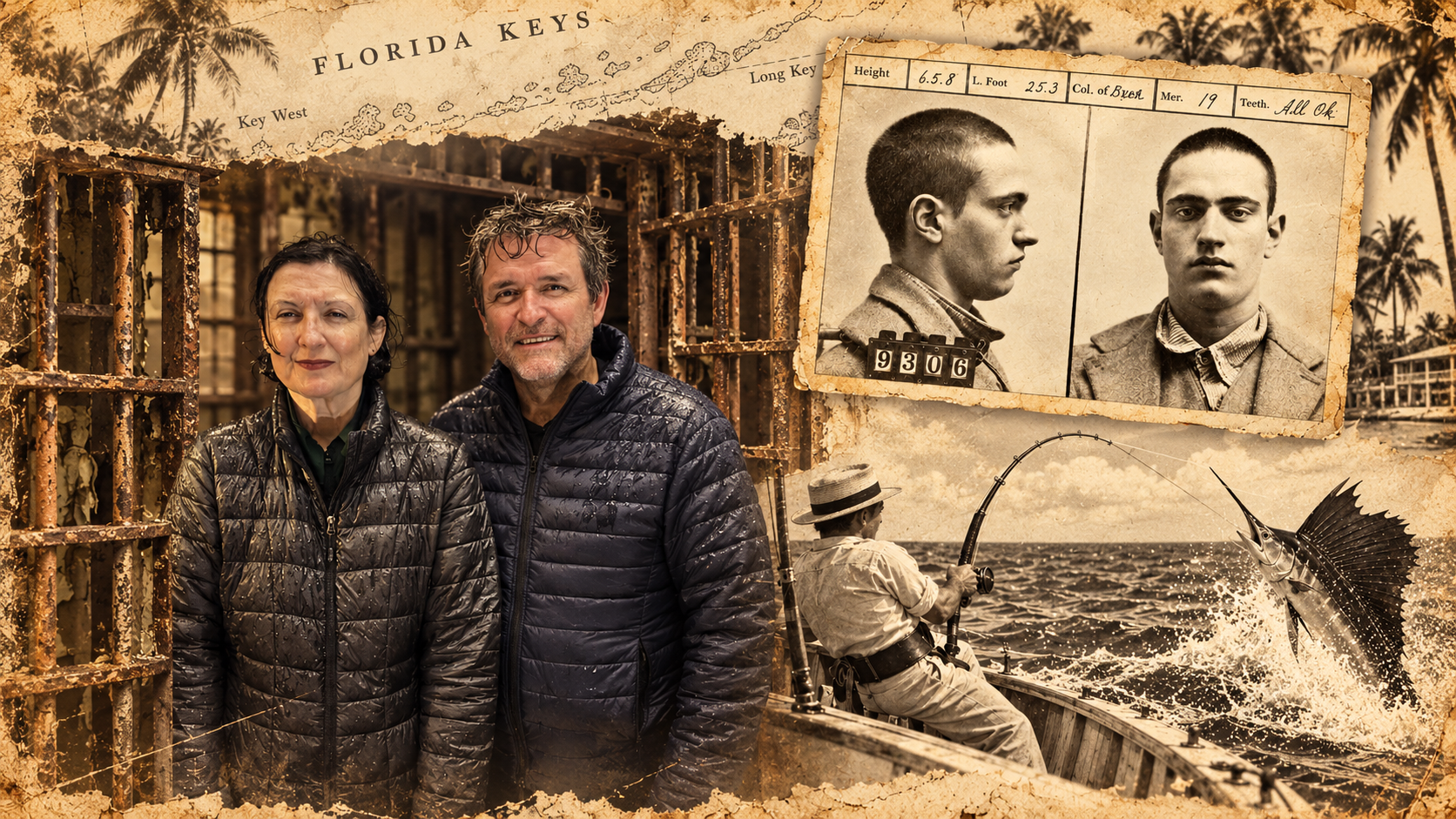
A collage connecting Nathan Leopold's imprisonment at Joliet Prison with his 1923 sailfishing adventure in the Florida Keys. The composition features David Sloan and Heather-May Sloan at Joliet Prison, Leopold's 1924 mugshot, and an illustration of a sailfish being caught off the Florida Keys.
How a 1923 fishing expedition to the Florida Keys left Nathan Leopold with a memory that survived 33 years in prison.
Florida Keys connections are everywhere, even in the abandoned cellblocks of Illinois' Old Joliet Prison. Heather-May and I recently explored the historic prison and got thoroughly soaked. Behind its imposing limestone walls, some of America's most notorious criminals once served their sentences. Among them were Nathan Leopold and Richard Loeb, two wealthy Chicago students whose 1924 murder of 14-year-old Bobby Franks became known as the "Crime of the Century."
Their story is one of the most disturbing in American criminal history. But hidden within it is an extraordinary connection to the Florida Keys, involving a fishing trip, a mounted sailfish, and a treasured possession Leopold spent decades trying to reclaim.
The Crime of the Century
Nathan Leopold and Richard Loeb seemed destined for remarkable futures. Both came from wealthy Chicago families, showed exceptional academic ability, and enjoyed privileges most Americans would never have. Leopold graduated from the University of Chicago at 18, while Loeb graduated from the University of Michigan at 17. The young men also shared a dangerous fascination with crime and the belief that their superior intelligence would allow them to commit murder without being caught. They spent months planning what they considered the perfect crime, not for financial gain or revenge, but largely to demonstrate that they could get away with it.
On May 21, 1924, Leopold and Loeb lured 14-year-old Bobby Franks, a neighbor and distant relative of Loeb, into a rented automobile as he walked home from school. Once inside, Franks was struck with a chisel and killed. The pair concealed his body in a drainage culvert near Wolf Lake, south of Chicago, then attempted to disguise the crime as a kidnapping.
The following morning, Bobby's father received a ransom letter demanding $10,000 for his son's safe return. But the plan had already unraveled. A railroad worker had discovered Bobby's body, and investigators found a pair of eyeglasses near the scene. They traced the unusual hinges to just three purchasers in the Chicago area, one of whom was Nathan Leopold. The discovery led investigators to the two young men, who eventually confessed. Their arrest stunned the country. Newspapers devoted enormous coverage to the case, struggling to explain how two privileged, highly educated students could commit such a calculated and senseless act.
Their families retained Clarence Darrow, one of America's most celebrated defense attorneys. Rather than contest their guilt, Darrow entered guilty pleas and concentrated on saving his clients from execution. His lengthy arguments against capital punishment became a landmark in American legal history. In September 1924, Leopold and Loeb were sentenced to life imprisonment for murder, plus 99 years for kidnapping, and sent to Joliet Prison. Loeb died in prison in 1936, while Leopold remained incarcerated until his parole in March 1958. But just 18 months before entering Joliet, Leopold had enjoyed an entirely different adventure, one that would remain close to his heart for the rest of his life.
A Sailfish Off Long Key
On March 20, 1923, Nathan Leopold graduated from the University of Chicago with a Bachelor of Philosophy degree. To celebrate, his father treated him and his friend Henry Hirsch, another recent graduate, to a vacation in Florida and Cuba. Leopold was already an accomplished naturalist with a particular interest in birds, but he had never experienced deep-sea fishing. During their travels, the young men arranged an offshore excursion aboard the Tramp, commanded by Captain Alfred Hutter, an experienced fishing guide who had operated in South Florida waters for years.
On March 31, the two young men embarked on what would become one of Leopold's most memorable adventures. Their fishing expedition included a cruise to Long Key, a destination already famous among anglers seeking the powerful game fish that inhabited the surrounding waters. Ernest Hemingway would later help make this sort of battle with a sailfish legendary in the Florida Keys. Five sailfish escaped before the fishermen finally landed a magnificent 55-pound specimen measuring about 6 feet, 3 inches.
The April 2, 1923, edition of The Miami News reported their accomplishment under the headline "Chicago Anglers Are Lucky on First Trip." The newspaper named Leopold and Hirsch, described their cruise to Long Key, and reported that the visitors intended to have their prize mounted as a permanent reminder of the adventure. Leopold followed through. They professionally mounted the sailfish on a substantial wooden base and displayed it in his family's Chicago home, where it became one of his most prized possessions. Unfortunately, it would hang there for barely a year before the events surrounding Bobby Franks's murder changed Leopold's life forever.
A Treasure Left Behind
Before entering prison in September 1924, Leopold made arrangements to donate much of his extensive natural history collection to the Elgin Audubon Museum in Illinois. The collection included bird specimens, nests, eggs, insects, and the mounted sailfish from his Florida fishing expedition.
Leopold spent more than 33 years behind bars, first at Joliet and later at Stateville Correctional Center. During those decades, the world outside changed dramatically, and the young man who had once enjoyed every privilege of wealth and freedom grew into middle age behind prison walls.
We'll never know how often his thoughts returned to the warm waters of the Florida Keys, or whether memories of that fishing trip offered some escape from the routines of prison life. We do know, though, that Leopold never forgot his prized sailfish. After being paroled in March 1958, he moved to Puerto Rico, where he married and began rebuilding his life. Five years later, during a return visit to Illinois, a friend arranged an unexpected reunion with something from his distant past.
The Fish in the Basement
In 1963, Leopold's friend Harold Row took him to the Elgin Museum, where parts of his old natural history collection were still on display. The museum's curator guided them through the exhibits, showing Leopold the birds, nests, and eggs that he had donated nearly four decades earlier. Eventually, the curator led them into the basement, where the museum stored specimens not currently on exhibition. Leaning against a wall and sitting on the floor was the sailfish Leopold had caught during his 1923 fishing expedition. Time had not been kind to the trophy. One of its fins had broken off and disappeared, leaving the mounted fish unsuitable for exhibition. The museum had no plans to display it again, so it was relegated to storage.
According to Row, the discovery moved Leopold deeply. The sailfish was more than an aging specimen. It connected him to an afternoon on the water when he was 18, celebrating his graduation and looking forward to a future that had seemed limitless. During his flight back to Puerto Rico, Leopold wrote a letter to Row explaining how much he wanted the fish returned. He described it as his "piscatorial pride and joy" and explained that, although the specimen had no scientific value, it remained the only sailfish he had ever caught.
Leopold acknowledged that he had donated the collection and had no intention of reclaiming it. But he argued that the damaged sailfish did little good gathering dust in a basement, especially when it meant so much to him personally. Row contacted the museum's curator, who agreed to release the fish.
NATRU Comes Home
In February 1964, more than 40 years after Leopold's fishing expedition, the museum carefully packed the mounted sailfish in a crate and shipped it to Puerto Rico. Leopold was delighted when it arrived. He named the fish NATRU and arranged to display it in his study. In a letter to his brother, he described the sailfish's enormous glass eye watching him reproachfully from the floor as he waited for help hanging it on the wall.
Once the fish was mounted, Leopold occasionally found himself distracted from his writing as he looked up at his old trophy. It became a permanent reminder of his youth and an adventure that took place long before the events that would define his public life. The sailfish traveled from the waters of South Florida to a wealthy Chicago home, spent decades in an Illinois museum, and finally reached Puerto Rico. Over those years, its significance to Leopold apparently never diminished.
The Magic of the Florida Keys
Standing in the rain at Old Joliet Prison, it's difficult to imagine the privileged life Nathan Leopold knew before entering its gates, much less picture him aboard a fishing boat in the warm waters around Long Key. His crime was horrific, and nothing about his attachment to a fish diminishes the terrible loss suffered by Bobby Franks and his family. Yet the story offers an unusual glimpse into how a single experience can remain meaningful across decades, even as nearly everything else in a person's life changes.
For Leopold, the mounted sailfish became part of his identity. Forty years after catching it, he went to considerable trouble to have that memory returned to him, not because the fish was particularly valuable, but because of what it represented. Even the name NATRU was a portmanteau of his name, Nathan Rudolph Leopold.
I've always believed the Florida Keys have that kind of power. People arrive here from every imaginable background, carrying their own histories, ambitions, and troubles. Some remain for a lifetime, while others spend only a few days exploring the islands before returning to lives elsewhere. But once you've experienced the magic of the Florida Keys, it never really leaves you.
Nathan Leopold's sailfish is one of the more unusual reminders of that permanent connection.
Historical Sources
The Miami News, April 2, 1923, page 11. "Chicago Anglers Are Lucky on First Trip." Contemporary account of the fishing excursion involving Nathan Leopold, Henry Hirsch, and Captain Alfred Hutter.
Erik Rebain, "Spring Break '23," The Lives and Legends of Richard Loeb and Nathan Leopold, September 15, 2023. Historical research drawing on Leopold's correspondence with Harold Row and his family.
PBS American Experience, "The Trial of the Century" and "The Leopold and Loeb Trial." Historical background on the murder, investigation, defense, and sentencing.
University of Minnesota, Clarence Darrow Digital Collection, "The Leopold & Loeb Trial." Historical case documents and legal context.
